Multi-line upgrade, AT&T
Most upgrades are a single device, so the system was built for one. When a household upgraded several, it made them start over for every line.
- Role
- Design lead
- Team
- Four designers across cart and account management, plus PM, research, business and analytics, engineering and order management
- Year
- Early 2025
- Scope
- Research direction, purchase-model definition, flow architecture, testing
The ask
One sentence arrived with the project: improve the experience for customers upgrading multiple phone lines. No behavioral data, no named pain points, no definition of what success would look like.
What I had was a subject rather than a problem, and four designers on other surfaces whose work would have to agree with mine. So the first month went into investigation instead of wireframes — behavioral datasets, real customer paths, and the order constraints underneath them — because a brief that does not contain a problem cannot be designed against.
What came back reframed the work. This was not a flow that had grown awkward. It was a purchase system built on the assumption that an upgrade is one device, sitting underneath households who upgrade several at once.
The wrong unit of purchase
The complaint arrived as one thing. The research separated it into three, and only one of them was a design problem — which mattered, because fixing that one alone would have left the other two intact.
The order model allowed one. An order could carry a single NU/NUA device, so a household upgrading three phones was structurally forced into three orders — three shipments, staggered arrivals, a more complicated bill. No amount of flow design removes a constraint that lives in order management.
The buy flow assumed one. Every additional device meant starting again from the top — device, trade-in, add-ons — for a household that had already worked through those decisions once. More passes meant more time, more abandonment, and more room for the lines to end up inconsistent with each other.
Nothing told anyone it was possible. Multi-line upgrades were barely surfaced, and web, app, store and support each described them differently. Customers who might have completed one often did not know it existed.
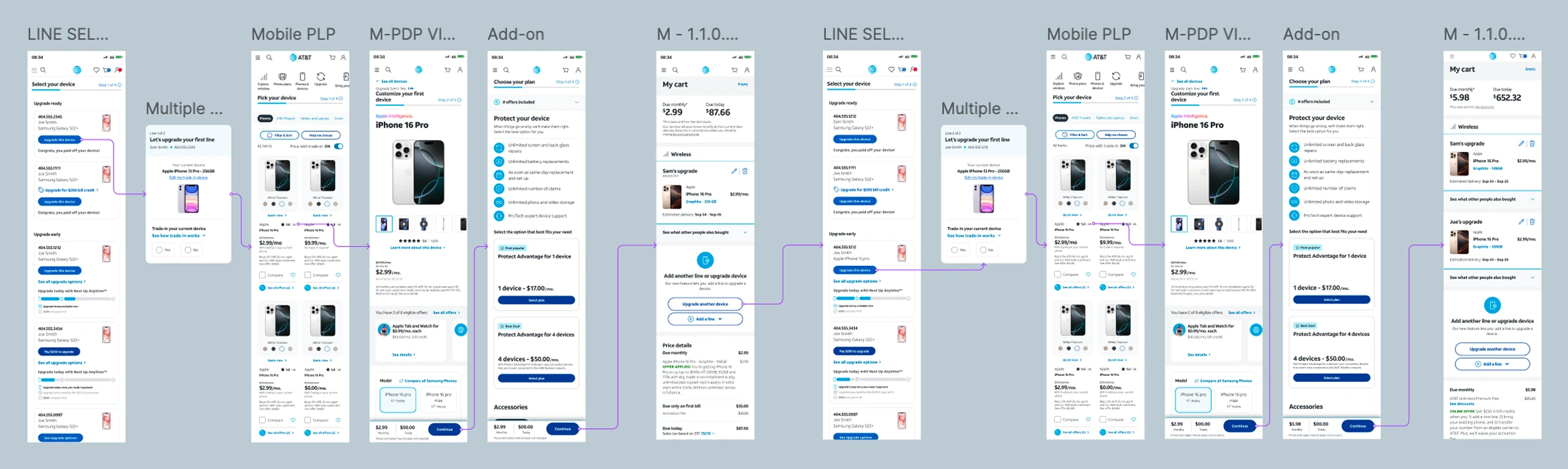
The demand gap
The argument that funded this work was not in the complaints. It was in the distance between how households upgrade in a store and how they upgrade online — and nobody had gone looking for it.
No one asked me to. I went to the business and analytics teams without knowing what I was looking for, only that the brief contained no evidence and someone had to produce some. The first questions were naive. Each answer raised a better one, and after a few rounds of that I knew enough to ask for the specific behavioral cuts that turned out to matter: how many devices a household upgrades at once, whether they stay with one manufacturer, and how digital compares with retail.
Those three cuts are the entire foundation of this project.
Multi-line is a minority behavior in both channels — 16% of retail upgrades, 6.5% online. The argument was never that everyone wants this. It is that the people who do want it succeed two and a half times more often in the channel that accommodates them, and fail in the one that does not. Retail was not better at persuading anyone. It simply let a household buy the way a household buys.
The second set of numbers decided the design. If 94% of multi-line upgraders stay with one manufacturer and two thirds pick the identical model on a second line, the flow was asking the same question repeatedly and getting the same answer nearly every time. That is not a household making several decisions. It is a household making one.
Changing the unit
If the household is the unit of purchase rather than the device, three things follow. The journey starts from the lines, the price resolves before configuration, and nothing gets configured twice.
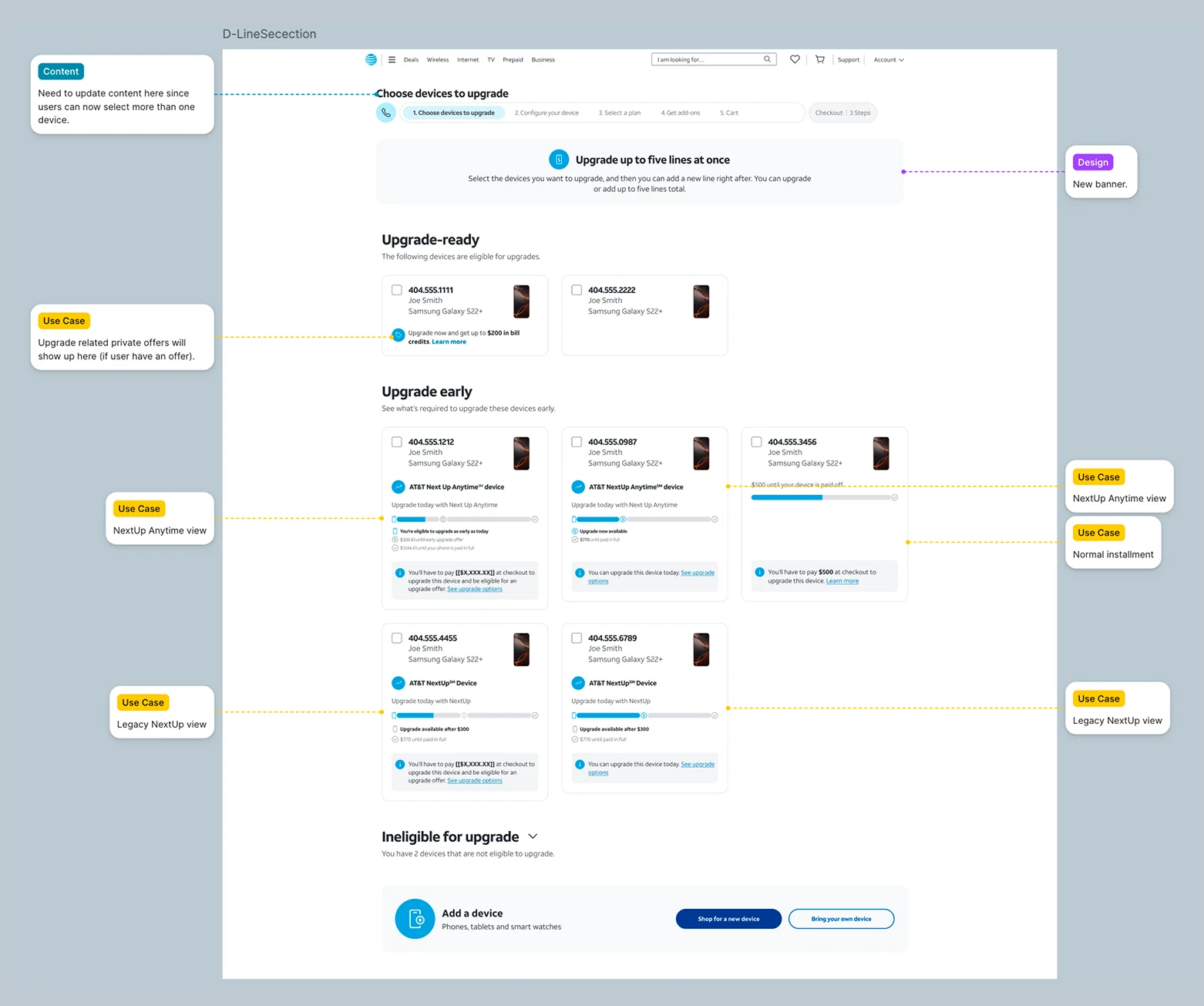
Start from the household, not the handset. The journey opens on line selection, where a customer picks every line they intend to upgrade before configuring any of them. Lines are grouped by what is actually possible — ready to upgrade, upgradeable early with a pay-off owing, or ineligible — so the financial commitment is visible before the effort is spent rather than after.
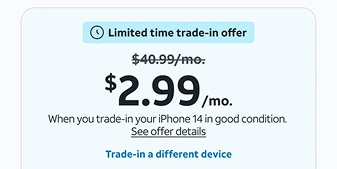
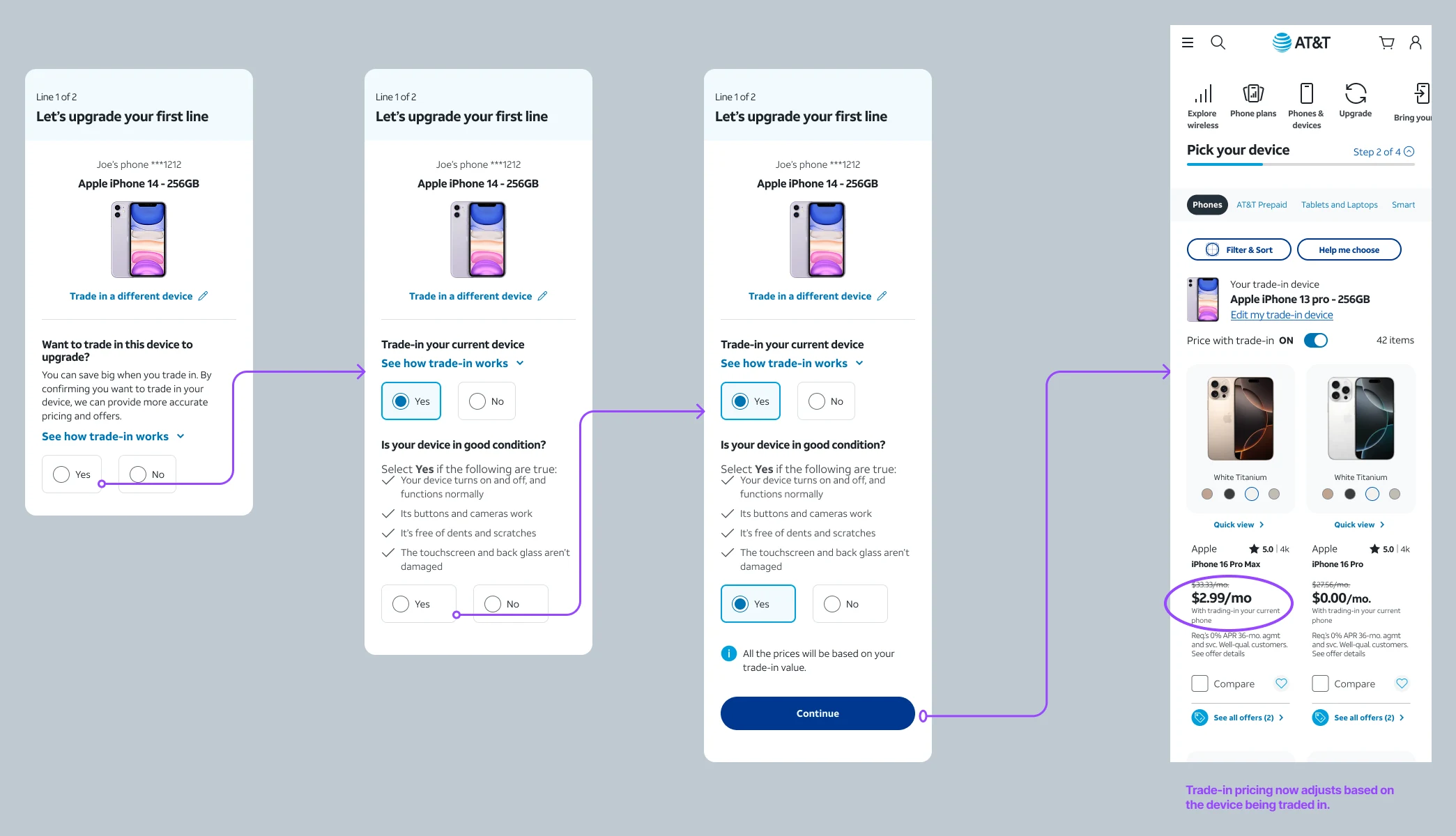
Resolve price before configuration, not after. Promotions depend on whether a customer is trading in and whether that device qualifies, which is why an advertised price so often failed to survive to the cart. Asking for trade-in intent up front lets the price shown be the price that applies, and keeps it changeable at any point without restarting anything.
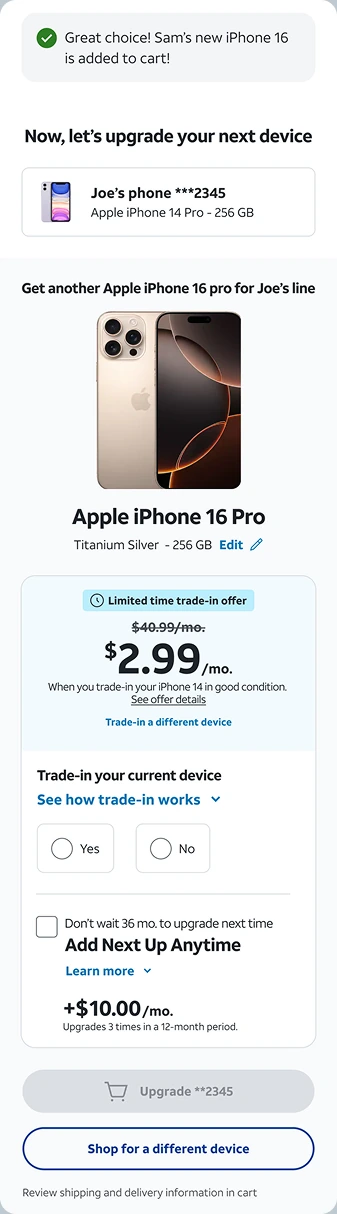
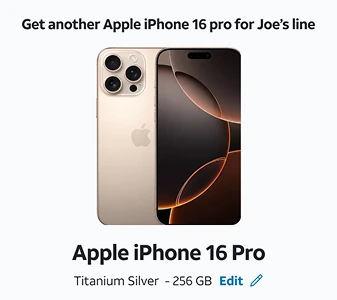
Duplicate a line. Once the first line is configured, the rest inherit it — skipping the buy flow entirely. Disagreeing with the default is deliberately cheap at two different scales: Edit adjusts color and capacity in place, and shopping a different device returns to the full catalog. This is the move the research earned: 94% same manufacturer, two thirds identical model, turned into an interaction rather than a shortcut.
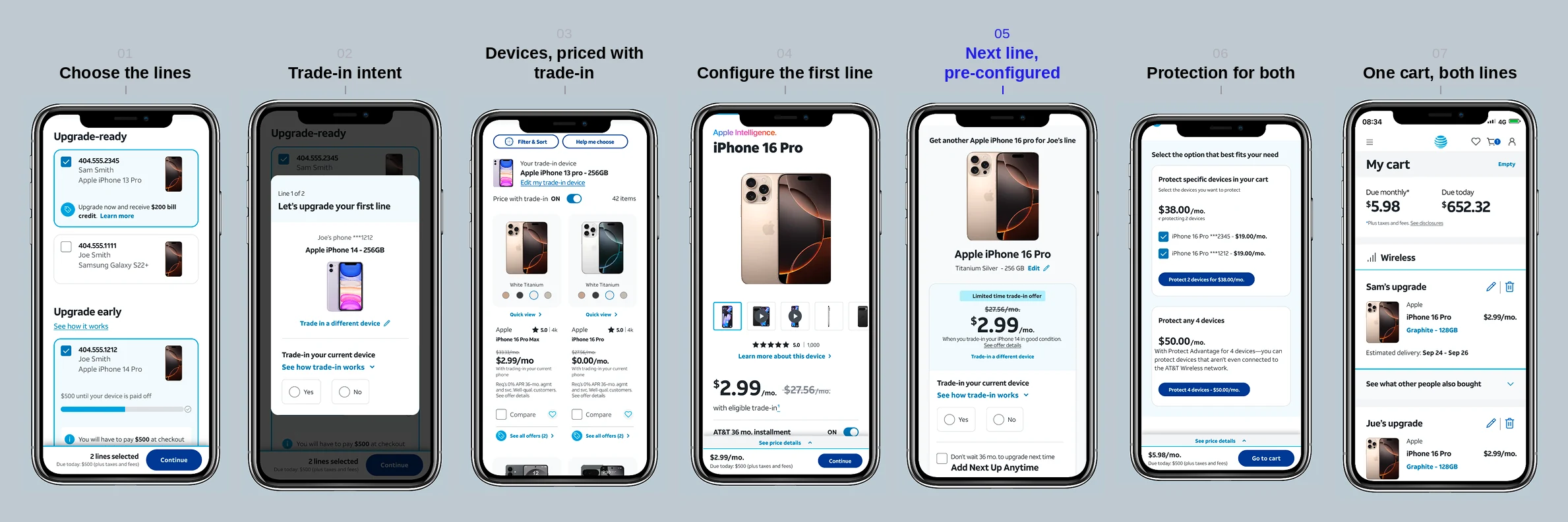
Proving it out
Two rounds — a survey of 75 and a deeper study of 15 — tested whether a household would accept a purchase it had not configured itself.
The load-bearing idea validated almost immediately. Had a pre-configured device felt presumptuous rather than helpful, the case for changing the unit of purchase would have collapsed with it — so this was the result the whole model depended on.
The third number is the one I would raise in a review. Only 62% easily understood how to leave the pre-configured device behind and shop the catalog for a different phone — the larger of the two exits, and the one that matters when the assumption is simply wrong for that household. A flow that assumes on your behalf has to make disagreeing with it effortless.
So we changed it. The design was iterated after this round specifically to make the route to a different device unmistakable, and that is the version that went on to test and to ship. A study is only worth running if a bad number moves something, and this one did.
Both rounds were also asked what information matters when upgrading a second device, and both returned the same order: monthly installment cost first, available offers second, whether a trade-in is required third. Add-ons came last.
That ranking settles two arguments at once. It is the evidence for resolving price before configuration — the thing people most want to know was the thing the old flow answered last. And it turns the add-on result from a usability note into a priority inversion: the least important information on the page was the only section opened by default, and 39% found that confusing.
The idea we were least sure of tested best. The detail nobody had questioned tested worst.
Where it landed
All three changes are live and have been in production for several months. Two of them were measured.
Choosing the household up front. Multi-line selection shipped and is how the upgrade journey now begins — up to five lines at once, grouped by what each line can actually do.
Resolving price before configuration. Capturing trade-in intent before device browsing, and carrying that selection into list pricing, closed the gap between the price shown early and the price that actually applied. Cart conversion rose from 39.9% to 43.4%.
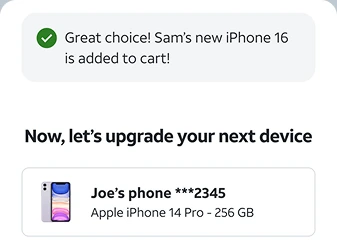
Upgrading the next line without restarting. The interstitial that offers the same device for the next line — the 94% figure turned into an interaction — produced a 400 basis point lift in conversion.
The second result is the one that settles the argument the case study opens with. A household offered the same phone for the next line, without being returned to the start, converts measurably more often — which is what it looks like when the unit of purchase finally matches the way people buy.